Subscribe Us

Responsive Advertisement

Feeling tight and tired after exercise? Whether you’re recovering from injury, or have consistent niggles and tension, a thorough mobility a...

STRETCH, TWIST, RECOVER  STRETCH, TWIST, RECOVER

Feeling tight and tired after exercise? Whether you’re recovering from injury, or have consistent niggles and tension, a thorough mobility and stretch sequence is one of the most valuable additions to your daily  schedule. While stretching exercises will keep muscles flexible and healthy, mobilising moves will support these benefits by increasing your range of motion.


Enter this sequence of active recovery exercises. The bodyboosting session is designed to help improve mobility in day-to-day life, as well as release tension from tight muscles and reduce the risk of injury.


How to do it


Follow the moves in order, moving from one exercise to the next. Throughout this sequence, try to hold each exercise for as long as feels comfortable, focusing on controlling your breathing throughout. Relax into the positions – don’t overstretch, as you shouldn’t feel pain when doing these movements.


CHILD’S POSE TO UP DOG


Child’s pose is a great and very gentle stretch for the back, hips, thighs and ankles. Up dog helps stretch the upper back, chest and abdomen. Together, they make a great mobility drill for the whole body.


• Start kneeling on the floor with your toes together and your knees hip-width apart.

• Sit back on your heels and lower your torso towards the ground, extending your arms overhead (A).

• Stay here for 20-30 seconds, or as long as you feel comfortable, then transition into Up dog by lying flat on your stomach. Keep your hands on the floor, slightly out in front of you. Start to lift your torso off the floor, keeping your hips on the mat (B). To make it more challenging, keep arms straight.

• Stay here for 15-20 seconds, or as long as you feel comfortable, before transitioning back into child’s pose. Repeat both positions for up to 60-90 seconds.


LYING TWISTS


This is a mobility drill and stretch for the hips, back and shoulders. The ‘twist’ motion is a fantastic way to release tension in the spine.


• Start lying on your back, brace your core and raise your legs off the floor, keeping your knees bent at a 90-degree angle. Extend your arms out to the sides (A).

• Slowly drop both knees down to the left side towards the floor, keeping both shoulders on the floor.

• Turn the head to face the opposite direction from the knees and hold in the twist for 20-30 seconds or as long as feels comfortable (B), then switch to the other side.

• Continue to alternate sides for a total of 1-2 minutes.


KNEELING HIP FLEXOR INTO HAMSTRING STRETCH


Both the hip flexors and hamstrings are affected by sitting for long periods of time, so this is a great way to stretch them out.


• Kneel on one leg with your left leg in front  and right leg behind. Tuck your pelvis under and slightly drive the front knee forward, without arching the lower back.

• To increase the stretch, raise your right arm above your head, squeeze your bum and feel the stretch in the front of the right hip (A). Hold for 20-30 seconds, or for as long as feels comfortable.

• From here, sit back onto your right heel and straighten the front (left) leg, keeping the heel on the floor. Place both hands on the floor for extra support (B). You should feel a stretch in the back of the left leg. Hold for 20-30 seconds or for as long as feels comfortable, then repeat both stretches on the same side 2-3 times before switching legs. 


CAT/COW


A back and spinal stretch will help ease tension and create length in the whole body – cat/cow is one of the fundamental mobility moves used for this.


• Start on all fours in a tabletop position, keeping your back straight, shoulders in line with the wrists and the hips in line with the knees.

• Press both hands into the fl oor and round your back, tucking your head towards your chest (A). Hold here for 10-20 seconds or for as long as feels comfortable.

• Transition into the opposite movement by arching the back and tilting the head upwards (B). Hold here for 10-20 seconds or for as long as feels comfortable. Continue to alternate positions for a total of 1-2 minutes.


LYING GLUTE STRETCH AND CHEST OPENER


This move will stretch the glutes, chest and back. It helps release so many muscle groups, plus is a great twist for the spine and lower back.


• Start by lying on your side with your left leg extended and your right leg across the left and bent to touch the fl oor in front of you. Both arms are stretched out in line with your shoulders (A). Hold in this position for as long as feels comfortable.

• From here, take the top arm (right arm) and open the chest by circling it across the fl oor behind you. Allow the head to follow, so you are now looking towards the right arm (B). Both arms remain stretched out. You will feel the twist in the back and the stretch across the chest and shoulders.

• Hold here for 10-20 seconds then return to the start. Continue alternating for 30-60 seconds, then repeat on the other side.


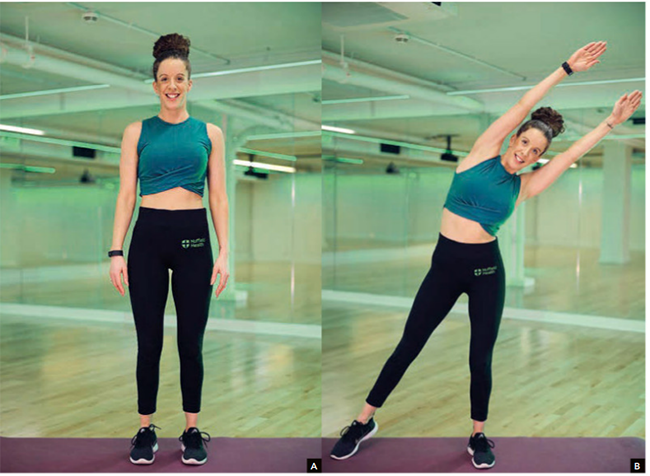
SIDE-STEP AND REACH


This is one of the key movements for stretching the torso and back, both large parts of the body that hold a lot of tension.


• Start standing with your arms by your side (A).

• Step your right leg out to the side, keeping a slight bend in the left leg. Reach your arms above your head and reach towards the left side to create a stretch down the side (B).

• Hold for 10 seconds before repeating on the other side. Alternate from side-to-side for 1-2 minutes.


UPPER BACK TO CHEST OPENER


We end with a mobility stretch drill for the chest and back, and this one feels glorious!


• Start standing with your knees slightly bent. Grasp your hands together like you are hugging a giant beach ball. Dip your head and reach your arms away from you (A). You should feel a stretch in your upper back.

• Hold for as long as you feel comfortable and then open the arms wide and take them slightly behind you. Lift the head if this feels comfortable and feel a stretch across the front of the chest (B).

• Hold here for as long as it feels comfortable then transition back to the start of the stretch. Repeat the sequence for up to a minute.

.

Looking for a tasty something that will help you get back on your A-game? These meals are packed with the goodness your body needs to refuel...

POST-WORKOUT PLATES  POST-WORKOUT PLATES

Looking for a tasty something that will help you get back on your A-game? These meals are packed with the goodness your body needs to refuel and recover after hard exercise.


We all know that what we eat in the hours after a tough workout counts, because a healthy balance of the right nutrients will give your body what it needs to replenish glycogen stores and rebuild muscle tissue damage, but what if it’s mealtime and you’re lacking inspiration? Then it’s high time you expanded your fitness fuel menu.


During exercise, small parts of your muscles get broken down and damaged, This means it’s important to get the right kind of carbohydrates and protein in your post-workout meals, to repair your muscles quickly and decrease how much they get broken down next time.


What should you be putting on your post-workout plate? Look for lean proteins like chicken, turkey, eggs and fish, or combine different plant-protein sources such as pulses, beans and nuts, plus complex carbohydrates like sweet potatoes, quinoa, rice and oats. ‘If I’m training in the evening, our honey chicken with stir-fried rice makes for the perfect meal, with a healthy balance of protein, fats and carbs, plus three of your 5-A-Day.’


Hungry? Read on for three post-workoutworthy meals for after your next sweat session. Each meal boasts more than 40g of protein, plus are gluten-, dairy- and refined sugar-free, so you’ll feel stronger rather than sluggish.


MEXICAN HAKE WITH BLACK BEANS & GUACAMOLE


Cook time: 15 mins

Per serving: 516 cals, 43g protein, 33g carbs, 25g fat


Ingredients for 2


• 4 spring onions

• 1 handful of fresh coriander

• 1 lime

• 110g baby plum tomatoes

• 2 hake fillets (skin off)

• 2 tsp smoked paprika

• 240g black beans (drained)

• 50g sweetcorn (drained)

• 1 tsp ground cumin

• 1 avocado, destoned

• 1 little gem lettuce, sliced

• Oil, for frying


1. Thinly slice the spring onions. Roughly chop the coriander. Halve the lime. Halve the tomatoes.


2. Heat a medium non-stick frying pan with ½ tbsp oil on a high heat. Season the hake with black pepper and half the paprika. Pan-fry for 2-3 mins on each side, until golden and cooked through. Keep warm in the pan.


3. Drain the beans and sweetcorn, then rinse. Heat a second frying pan with ¼ tbsp oil on a medium heat. Add half the spring onions, cook for 1 min, then add the beans and sweetcorn followed by the tomatoes, cumin and remaining paprika. Cook for 4 mins, add half the coriander, then season with black pepper.


4. Meanwhile, make the guacamole; add the remaining spring onions and half the remaining coriander to a bowl with the juice from half the lime. Spoon the flesh of the avocado into the bowl and roughly mash with the back of a fork. Season.


5. To make the dressing, add the remaining coriander, remaining lime juice and ¼ tbsp olive oil to a small bowl.


6. Serve the warm beans topped with the fish, and the guacamole and sliced lettuce on the side. Drizzle over the dressing.


TOFU SAAG WITH CORIANDER QUINOA


Cook time: 20 mins

Per serving: 633 cals, 46g protein, 55g carbs, 29g fat


Ingredients for 1


• 40g quinoa

• 280g naked tofu

• 1 shallot

• 2cm fresh ginger

• ½ red chilli

• 1 handful of fresh coriander

• ½ lemon

• 2 garlic clove

• 1 tsp cumin seeds

• 1½ tsp Mindful Chef Sri Lankan spice blend (coriander, fenugreek, cumin, fennel, cayenne, cinnamon, cardamom, curry leaves, clove)

• 1 large tomato, chopped

• 80g baby spinach

• 150g peas

• Oil, for frying


1. Fill a small saucepan with salted boiling water. Add the quinoa and boil for 13-14 mins, until cooked, then drain.


2. Drain the half block of tofu, pat dry with a paper towel and cut into 3cm cubes, put into a small bowl and toss with half the spice blend. Heat a medium frying pan with 1 tsp oil on a medium heat. Cook the tofu for 8-10 mins, turning occasionally, until golden. Season with sea salt, then remove from the pan.


3. Meanwhile, finely slice the shallot. Finely chop or grate the ginger. Finely dice the chilli (remove the seeds for less heat). Roughly chop the coriander. Zest and quarter the lemon.


4. Reheat the empty frying pan over a medium-high heat with 1 tsp oil. Add the shallot, ginger, garlic, cumin seeds and remaining spice blend. Cook for 2-3 mins, until softening and fragrant. Add the tomato, cook for 2 more mins, then return the tofu to the pan along with the spinach and peas. Cook, stirring, for 3-4 more mins, until the peas are hot and the spinach is wilted.


5. Stir half the coriander through the quinoa and the other half through the tofu saag. Season the saag with a squeeze of lemon juice and a pinch of sea salt and black pepper.


6. Serve the quinoa in a bowl with the tofu saag on top.


HONEY CHICKEN WITH STIR-FRIED RICE


Cook time: 30 mins

Per serving: 538 cals, 45g protein, 47g carbs, 20g fat


Ingredients for 4


• 160g brown rice

• 2 red pepper

• 4 spring onions

• 150g sweetcorn (drained)

• 20g white sesame seeds

• 2 tbsp tamari

• 25g honey

• 2 tbsp rice wine vinegar

• 2 tbsp tomato purée

• ½ tsp Chinese five-spice

• 600g diced free-range chicken breast

• 1 head of broccoli


1. Rinse the rice, then add to a saucepan with 800ml boiling water and a pinch of sea salt. Simmer for 20-25 mins, then drain. Set aside the rice; reuse the pan for the broccoli later.


2. Cut the peppers into bite-sized pieces. Cut the broccoli into florets. Thinly slice the spring onions. Drain the sweetcorn. Toast the sesame seeds in a large, non-stick dry pan on a medium heat, stirring constantly, until evenly  golden. Transfer to a small bowl and set aside. Keep the pan for later.


3. Make the sauce. In a small bowl mix together the tamari, honey, vinegar, tomato purée and five-spice. Heat the pan used earlier with 1 tbsp oil on a medium-high heat and cook the peppers and sweetcorn for 5 mins, until softening. Add the cooked rice and mix thoroughly. Season with sea salt and black pepper; cover to keep warm.


4. Meanwhile, heat a separate large pan with 1 tbsp oil on a medium-high heat. Cook the chicken for 6 mins, turning occasionally. Season, then add the sauce with 50ml water. Cook for a further 2 mins to reduce slightly. Check the chicken is cooked through; cut a large piece in half, the flesh should be white and the juices running clear.


5. Simmer the broccoli in a pot of lightly salted boiling water for 2 mins or until it is cooked but still retaining a slight bite. Drain; season with sea salt and black pepper.


6. Serve the fried rice, broccoli and chicken garnished with the spring onions and sesame seeds. 

Want to improve your diet but feeling overwhelmed by the advice that’s out there? From eating for better health, to fuelling your workouts, ...

30 WAYS TO EAT BETTER  30 WAYS TO EAT BETTER


Want to improve your diet but feeling overwhelmed by the advice that’s out there? From eating for better health, to fuelling your workouts, here are 30 easy tips to follow.


Exercising regularly and training with sufficient intensity is all well and good, but if your nutrition isn’t up to scratch, you won’t be getting the most bang for your buck from those workouts you’ve been slaving over.


You know about protein, the importance of fruit and veg, and why too many post-work drinks aren’t  doing you any favours in the quest to shift belly fat, but there are some other crucial tweaks you could be making.


You’re busy, we get it. And sometimes the food you eat day-to-day is the last thing  on your mind. So we’ve rounded up some simple, expert-approved and scientifically backed nutritional tips to nudge you a little further in the right direction...


EATING FOR FAT LOSS


1. Chew your food


Chew, chew and chew again. Studies have found that chewing your food properly decreases your hunger as well as your food intake. Try 20 chews per bite.


2. Don’t empty the tank


While calories in versus calories out is the fundamental equation for fat loss, it’s also important to consider what else you’re doing.


If you’re training hard, you need to adjust accordingly. Plan your meals in line with your exercise and work schedules, and take into account carbohydrate and energy requirements for each.


If you’re exercising less, you may need to decrease the amount of carbohydrate you’re consuming (if fat loss is the aim). But carbs are not the enemy, and if you start exercising more frequently again you should gradually increase your intake.


3. Fill up with ‘volume foods’


’Volume foods, such as spinach, lettuce, cucumber, gherkins and cabbage, can bulk out a meal for increased satiety without masses of calories,’ says Liam Holmes, nutritionist and Foodspring (foodspring.co.uk) ambassador.


4. Pick your plates


When participants in one study ate their meals off white plates, rather than black or red, their food intake was reduced.


5. Spice things up


We’re not suggesting you blow your head off with Carolina reapers, but research in 2014 found that the capsaicin in chilli peppers could help with feelings of fullness, avoiding the need to reach for more food after mealtimes.


6. Cut calories sensibly


Dropping down to 500 cals a day won’t be something you can sustain for very long.


’Reduce calories by about 10 to 20 per cent,’ says specialist dietician Nichola Ludlam-Raine. ‘If you’d usually consume 2,500 calories a day, start with a reduction of 250.’


Cut calories too drastically and you’ll lack the energy to exercise. Not only that, your body may also start to lower its metabolic rate in order to conserve energy – making it harder to shift any unwanted flab.


7. Eat for sleep


A decent night’s shut-eye plays a big part in weight loss, and the right foods can help you get it. In particular, tryptophan-rich foods are key. ‘Your brain needs tryptophan in order to make the sleep hormone melatonin,’ according to nutritionist and gut health specialist Marilia Chamon. ’Good sources include fish, eggs, rice, oats, chickpeas, soybeans, tofu, chia, sesame seeds and pumpkin seeds.’


EATING FOR GOOD HEALTH


8. Manage meat intake


‘Go meat-free at least once a week,’ advises Rob Hobson, head of nutrition at Healthspan Elite (healthspanelite.co.uk). This is not only good for your health, but has you doing your bit for the environment. ‘Swap chicken for Quorn or marinated tofu in a stir-fry,’ he adds, ‘and swap mince in a bolognese sauce or chilli for Quorn mince or canned beans.’


9. Hit the magic number


‘When it comes to hitting your 5-A-Day fruit and veg quota, one portion equals 80g,’ says Ludlam-Raine. ‘This should come from different coloured fruit and vegetables, as each different food has a unique set of nutrients.’


10. Fill up with fibre


Only nine per cent of adults meet the recommended 30g a day. ‘Fibre helps reduce the risk of heart disease, high cholesterol, type 2 diabetes and colorectal cancer, while also helping you to maintain body weight,’ says Hobson. ‘Eat more vegetables, switch to brown, wholegrain carbs and eat more legumes,’ he adds.


11. Fish for your supper


To keep your ticker healthy, tuck into at least two portions of oily fish a week. Think mackerel, sardines and salmon, which studies – published in the journal Frontiers of Nutrition – have shown could also prevent or slow down the development of brain disorders, such as Parkinson’s. All thanks to oily fish’s anti-inflammatory nutritional make-up.


12. Add more veg


Yeah, yeah, yeah, the usual. But this is the simplest way to improve your overall health and reduce your risk of disease. ‘Always think, add one more,’ says Hobson. ‘Keep “easy” veg, such as frozen peas and soya beans, to hand, which can be added to any hot meal. ‘Spinach is the same, and green beans or tenderstem broccoli are also hassle-free and quick to prepare.’


13. Be balanced


Eating a balanced diet will ensure you get the nutrients your body needs to support your immune system, but it’s also advisable to supplement with vitamin D during the winter months. ‘Probiotics may be useful for immune health during periods of intense training,’ Hobson adds. ‘And if you’re travelling overseas to compete, try starting a course or probiotics a couple of weeks beforehand.’


14. Be wary of sports drinks


‘They’re basically full of sugar,’ says Hobson, ‘and only of benefit to those training aerobically or competing in races lasting more than an hour. When you’re training in the gym, you need nothing more than water.’


EATING FOR STRENGTH


15. Look for leucine


‘This amino acid stimulates muscle protein synthesis, which helps to initiate regenerating and building muscle mass,’ says Ludlam-Reine. Leucine is mostly found in animal proteins: eggs, milk, whey powder, meat and fish. Plant-based? ‘Opt for complete sources of protein, such as soya, vegan protein powders (which contain all the essential amino acids) and mycoprotein.’


16. Recover right


Post-exercise nutrition is just as important as fuelling your body pre-exercise. Protein is vital for effective recovery, and the anabolic effect of consuming protein post-exercise is long-lasting.


Think about eating meat, fish or even plant-based foods to aid with muscle recovery and development. Oily fish, such as wild salmon, is high in omega-3 and can also help support with inflammation management.


17. Drink beets


A study published in the journal Nutrients found that when 70ml of beetroot juice was taken two hours before training, the total rep count of back squats and bench press increased.


18. Shake it off


‘A shake containing 25-30g of protein is ideal after a weights session. Any more won’t be used by the body,’ says Hobson.


19. Sleep on it


A study published in Frontiers in Nutrition found that 40g of casein, taken after an evening resistancebased workout and 30 minutes before sleep, could help with muscle recovery and increase protein synthesis.


20. Power up plants


Vegan or trying to cut down on animal products? ‘If your plant-based shake contains less than 20g of protein,’ says Hobson, ‘pair it with a small amount of carbs, as that will help with the protein uptake.’


21. Veg out


‘Polyphenols – the colourful chemicals found in plants – work to reduce inflammation, as well as improving the ability of the gut microbiome to produce helpful postbiotics, which play a role in better overall body composition,’ says Dr Federica Amati, nutritionist and chief nutrition scientist for Indi Supplements (indisupplements.com). Berries, beetroot, aubergine, red peppers and broccoli play just as big a role in muscle composition and strength as protein does.


EATING FOR ENDURANCE


22. Shell out


Long workouts can wreak havoc with joints. Glucosamine, available in supplements, can help with stiff joints. It’s also found in the shells of shrimp, lobster and crab.


23. Wait for nitrates


Proven to improve performance in endurance sports, Holmes recommends nitrate-rich foods, such as beetroot, rhubarb, carrots and green vegetables.


24. B better


A busy training schedule, alongside a hectic work life and stress, can deplete the body of nutrients. They include B vitamins, which support a healthy nervous system and help to break down food into energy for the body. Seafood, quality meat, leafy green veg and fortified cereals are all good sources of B vits.


25. Call for carbs


Make your mid-workout drink carbbased and simple. ‘Perfect for those longer sessions, carb powders, fruit juice or coconut water are all good options,’ says Holmes.


26. Manage your minerals


Sweating is your body’s defence system against overheating. Unfortunately, though, when you sweat, you also lose some important minerals known as electrolytes, including sodium and  potassium. Electrolytes support a number of bodily functions, including energy production and fluid balance.


‘It is very important to replace the electrolytes lost when you sweat,’ explains sports nutritionist Will Girling. ‘At best, you will see an unwelcome decline in your performance. At worst, you can get hyponatremia (low blood sodium), which can be deadly. So, during extended exercise, take on an electrolyte source once an hour. Around 400mg of sodium – or one electrolyte tablet – should cover most people,’ he adds.


27. Pump iron


‘Iron is an essential nutrient for endurance performance that is often overlooked,’ says Holmes. ‘Good sources include high-quality red meat, beans, seeds, dried fruit and leafy green vegetables.’


28. Be a GI Jane


‘If you’re training for any longer than 60 minutes, you may benefit from a high-GI source of carbohydrates for an immediate top-up of energy,’ says Ludlam-Reine. Try a handful of Jelly Babies or some Haribo.


29. Hit the scales


‘Training for one hour a day means eating 5-7g of carbs per kg of bodyweight,’ says Hobson. ‘Training one-to-three hours a day requires 6-10g per kg of bodyweight. But if you’re not used to eating high amounts of carbs, build up slowly to avoid any gut discomfort.’ No scales? Simply aim to fill a third of your plate with starchy carbohydrates.


30. Avoid pre-race fibre


It’s wise to carb-load 48 hours before any event lasting more than 90 minutes. ‘Aim for 10-12g per kg of bodyweight,’ says Hobson, ‘which will mean reducing your protein intake. Choose low-fibre carbohydrates to avoid any bloating or gut discomfort. Make sure you test this out before a long training session to establish your tolerance to carbohydrates, and on race day aim for 1-4g carbs per kg of bodyweight, four hours beforehand.’

Not thrilled by running or cycling? Here are four overlooked forms of cardio exercise you might not yet have considered. With physical activ...

FUN WAYS TO GET FIT  FUN WAYS TO GET FIT

Not thrilled by running or cycling? Here are four overlooked forms of cardio exercise you might not yet have considered.

With physical activity guidelines recommending we do 150 minutes of moderate-intensity activity (that which raises your heart rate a little), cardiovascular exercise is hard to swerve. But if you’re not wowed by the repetitive nature of going for a run, hike or ride, there are other options. Indeed, many people find their fix with team sports, interval training or even lifting weights in short bursts. But increasingly, throwback-style, playground-inspired activities have come to the fore as a popular way for adults to hit their cardio goals. The bonus? They’re a great way to stay active as a family, too. Why not give these four workouts a go this autumn?


SCOOTING


You might be used to standing on the sidelines while the kids whizz about on scooters, but scooting provides fitness benefits for all ages. As a low-impact but full-body form of exercise, it’s easy on your joints, great for cardiovascular health and simple to get to grips with. It provides a handy source of core conditioning, as well as building muscular endurance, and a speedy way to nip to the shops. Data shows you could burn up to 480 calories an hour on a scooter, but we reckon you could up that if you try to speed-scoot uphill! 


ROLLERSKATING


Head outside and get your endorphins flowing with rollerskating, for a fun activity that will hark right back to your childhood. It might take a bit of practice, but all of the balancing required while propelling your body forwards means you engage a whole host of muscles and get a really good workout. Skating is a great way to work your glutes, hamstrings, calves and inner thighs, but you’ll also find it provides a form of mindfulness, as you have to focus on your movements and staying balanced. There are lots of ways to do it – rollerskating, rollerdance, at a skatepark – but a typical one-hour ride on flat ground at a beginner level will burn up to 700 calories. Wow.


REBOUNDING


This trampoline-based form of exercise made a resurgence during the lockdowns, with many finding it to be a home-friendly way to keep fit. The mat of a mini trampoline is more taut than that on a bigger trampoline, which makes it a more focused workout for your core. Indeed, with the right technique, experts report that your workout will be three times more effective than the same moves done on the floor, thanks to the addition of gravity and G-force. It’s a low-impact (the trampoline mat absorbs 87 per cent of impact) and high-cardio form of exercise that will raise your heart rate, burn fat and boost your coordination. What’s not to love? 


HULA HOOPING


Get a little bit nostalgic by grabbing a hula hoop and revving up your heart rate. The secret to hula hooping success is to find an adult-sized hula and maybe even opt for a weighted one for an additional strength challenge. Requiring a lot of shimmying from your hips and waist, hula hooping is a great (and expressive) way to work your core. It will also boost your cardiovascular system and fire up the smaller muscles of your upper back, glutes and legs, plus you can get creative by squatting or moving around as you hula. It’s great for fat burn, too – a half-hour of hula hooping is said to burn up to 165 calories.

This fusion-style workout includes a series of cardio moves and Pilates-inspired exercises, which will hit every muscle in your body in less...

TOTAL BODY BLITZ  TOTAL BODY BLITZ

This fusion-style workout includes a series of cardio moves and Pilates-inspired exercises, which will hit every muscle in your body in less than 30 minutes.


Pilates is a form of exercise that concentrates on strengthening the body, with an emphasis on core strength, posture, balance and flexibility. High-intensity interval training (HIIT), n the other hand, is a form of exercise that raises the heart rate and improves cardio fitness. So, what happens when you combine the two together?


You get “Pilates HIIT”, a workout that mixes short bursts of intense activity with more controlled, low-intensity movements. These allow your heart rate to come down whilst you’re still moving mindfully and dynamically, and working the body to its maximum potential. It’s a great way to burn fat and increase fitness whilst improving flexibility, balance and core strength.


This workout is designed for those who love the idea of Pilates but want a quick and effective session that achieves a genuine result. If you’re short on time, this 25-minute workout will leave you sweaty and shaky, and feeling like you’ve had a creative workout. Fitness is about finding that balance, where you’re working hard enough to feel physically hallenged but still feel connected and mindful about what you’re doing.


HOW TO DO IT


These three circuits alternate between standing, high-intensity exercises and low-intensity Pilates mat moves. Complete one circuit, have a drink of water then do the next one. Repeat the whole workout three times through. 


CIRCUIT 1 - HIIT MOVE: SIDE STEP TO FLOOR TAP


Reps: 30-45 seconds


• Stand on your mat and take a big side-step to curtsy the left leg behind the right.

• Touch the floor with your left hand (A), then stand back up into a star shape (B) and repeat on the opposite side (C).

• Keep stepping from side to side, or pick up the pace by adding a light skip across the mat to make it quicker. Make sure you bend your knees to get low in the curtsy, and engage your core as you move.


CIRCUIT 1 - PILATES MOVE: CRISS-CROSS OBLIQUES


Reps: 30-45 seconds


• Lie down on your mat and bend your knees into a tabletop position. Curl your head up, taking your hands behind your head.

• Inhale to prepare and, as you exhale, pull the left knee in while rotating the right elbow towards it (A).

• Switch sides (B) and continue alternating, taking short exhales as you switch. Try not to pull on the back of the neck – think about bringing the armpit to the knee rather than the elbow – and aim to keep your pelvis stable.


CIRCUIT 2 - HIIT MOVE: JUMP SQUAT


Reps: 30 seconds


• Place your feet in a wide stance and turn your toes out slightly. Hold two dumbbells at chest-height (you can do this without weights if you prefer).

• Bend your knees to squat down, keeping your core engaged (A).

• Push off the ground to propel your body into the air (B). Land in the squat position and jump back into he air.

• To make it easier, don’t jump and instead extend your legs to return to standing, squeezing your bottom as you stand.


CIRCUIT 2 - PILATES MOVE: SINGLE-LEG BRIDGE WITH LEG PULL


Reps: 45 seconds (each leg)


• Lie on your back with your knees bent and your feet hip-width apart, arms by your sides.

• Inhale to prepare and, as you exhale, draw your abdominals in and lift your hips up into a bridge position.

• Lift one leg to the ceiling (A). Inhale to draw that leg down, so that it’s level with the bent knee, foot flexed (B).

• Exhale to point the toes and kick the leg straight back up to the ceiling.

• Repeat 5-10 reps on one leg, then switch legs to repeat and continue alternating. Keep your hips lifted, tuck your tailbone under, and engage your bottom and tummy to reduce any pressure in the lower back.


CIRCUIT 3  - HIIT MOVE: BACKWARDS LUNGE TO KNEE-LIFT


Reps: 30 seconds (each leg)


• Stand with feet hip-width apart and a dumbbell in each hand. Lunge backwards by taking a big step back with one foot and lowering the back knee towards, but not touching, the floor (A).

• Return to the starting position, taking the weights out in front of you and the back knee to hip-height (B).

• Lunge back as you lower the weights, repeating the move on the same leg. Continue for 30 seconds, then switch sides. 


CIRCUIT 3 - PILATES MOVE: KNEE-TO-CHEST TO DOWNWARD DOG


Reps: 30-45 seconds


• Start in high plank your feet hip-width apart. Engage your core, bottom and legs, and draw your shoulders down.

• Lift the right foot up and draw the right knee underneath you towards your chest, toes pointing (A).

• Return the foot back down and then send your tailbone to the ceiling, into a downward dog position (B). Stay high on your toes and focus on the stretch through your hamstrings and upper back/shoulders.

• Return to plank and repeat on the other side, then continue alternating.


If you think calorie counting is such a waste of time, Iwhat do I do instead? How do I prevent myself from eating too much? How do I stay at...

STOP COUNTING CALORIES AND 11 THINGS TO DO STOP COUNTING CALORIES AND 11 THINGS TO DO

If you think calorie counting is such a waste of time, Iwhat do I do instead? How do I prevent myself from eating too much? How do I stay at the same weight, year after year? The answer is simple.


6 REASONS TO STOP COUNTING CALORIES


1. Labels can lie


Yes. Labeling laws allow a 20% margin of error on the nutrition facts panel. That means your 100-calorie snack pack could be 119 calories. Or that 500-calorie TV dinner could be nearly 600 calories.


"The ratio between the amount obtained by laboratory analysis and the amount declared on the product label in the Nutrition Facts panel must be 120% or less, i.e., the label is considered to be out of compliance if the nutrient content of a composite of the product is greater than 20% above the value declared on the label."


2. Nutrients vary by season, variety, ripeness, etc.


While it’s nice to have the nutrient analysis of foods, there is no way food companies could analyze every variety of tomato from every region from every season from different growing conditions (i.e. organic vs. conventional) and every other variable for nutrients, including calories.


For e.g. super sweet summer tomato likely has more calories (and valuable nutrients) than that tasteless, pink one from the dead of winter. Which one would you rather eat?


3. "More calories equals weight gain" is not an exact science.


If calorie counting worked long-term, the USA would be the thinnest country in the world. We are a nation of compulsive dieters and you wouldn’t know it looking at us. The composition of what you’re eating is crucial to how many calories you eat and how many calories you burn.


In a comparative study of 3 diets: low-fat, low-glycemic, and lowcarb. It was observed that those on the low-carb diet burned 350 calories more than the low-fat diet. And yet, our nutrition guidelines recommend a low-calorie, low-fat diet. Trouble is, when you focus on calories, you’re likely to eat less fat (since fat is more calorie-dense than carbohydrate and protein). And when you eat less fat, you’re likely to eat more carbohydrates. See the problem?


If you’re happy eating tasteless, low-fat food, going hungry, and not losing weight, by all means, count calories and cut fat out of your diet."


4. We don’t absorb all calories.


It’s true! A study on almond consumption in humans found that up to 20% of the calories were not absorbed. (J Agric Food Chem, 2008) The exact reason is unknown, but possibly due to the “cellular structure” of nuts and the way our bodies digest food.


In summary, a calorie is not necessarily a calorie: given the functional differences between edible plants, interfamily and even interspecies differences must be considered when making comparisons between food processing techniques.


There’s good evidence that our gut health (and gut bacteria) plays a role in how many calories we absorb from our food.


5. Focusing On Calories Often Means We Restrict Healthy Foods.


This especially happens when it comes to fat. We often omit higher fat foods simply because they are higher in calories without taking into consideration what benefits we might get from them, such as staying fuller for longer (hungry), absorbing antioxidants from vegetables, and getting necessary nutrients, like fat-soluble vitamins.


(This is crucially important for pregnant women who may become deficient in key brain-building nutrients if they restrict fat.)


Choose to fully ignore calorie labels, especially on real foods that are naturally high in fat such as meat, fish, eggs, cheese, butter, avocados, olives, nuts, and seeds. There are innumerable benefits to eating them, and you cannot end up overeating every time


6. Too Much Math.


Honestly, NO one has the time or energy to calculate everything that goes into one’s mouth. That probably sounds odd, but this can be done and is best done without counting. Counting calories is especially fruitless when you know #1-5


11 THINGS TO DO INSTEAD OF COUNTING CALORIES


1. I listen to my body.

2. I always eat when I’m hungry.

3. I eat foods that I’m actually in the mood to eat.

4. I put my full attention on the meal in front of me.

5. I notice the sensations in my body before, during, and after eating.

6. I sit down when I eat.

7. I chew every bite before taking another.

8. I savor the flavors, texture, mouth feel, sounds, richness, crunchiness or softness, saltiness, or sweetness.

9. I make an effort to eat healthy foods and make an equal effort to eat the healthy foods that taste good to me.

10. I sometimes choose to eat foods purely for the pleasure of eating them, even when they are not “healthy”.

11. I sometimes choose to eat more food than is comfortable, either because the food tastes really good or because I know I won’t have time to eat again for a while (such as during a busy work day).

It’s frustrating: You’ve been working to build healthier habits but aren’t seeing a boost in energy or confidence. The truth is, your daily ...

SEVEN HABITS THAT MAY BE UNDOING YOUR HARD WORK SEVEN HABITS THAT MAY BE UNDOING YOUR HARD WORK


It’s frustrating: You’ve been working to build healthier habits but aren’t seeing a boost in energy or confidence. The truth is, your daily efforts might not be as helpful as you hoped. Check your routine for the following traps.


1. EATING TOO LITTLE 


In the truest sense, calories equal energy. And if you’re restricting calorie intake too much, your body lacks essential fuel.


In fact, when you significantly restrict calories, your systems don’t have enough energy to perform their most essential functions. Instead, the body adapts and tries to conserve energy, slowing down your metabolism in the process. This can lead to feeling sluggish, unfocused and even unmotivated.


While being mindful of your calorie intake, you should home in on nutrient-dense calories so your body gets everything it needs to run like a welloiled machine.


Nutrient-dense calories will fill you up with goodfor-you vitamins, minerals, fats and other must-haves so you can keep your body properly fueled and operating at its best.


Additionally, instead of cutting back on calories, try incorporating more foods that’ll satiate your hunger and help you feel fuller for longer periods of time. Filling foods deliver those much-needed, energy-generating calories without leaving you hungry or unsatisfied. One of the best options? Protein! Protein powers nearly every one of your body’s systems, from cell repair to strengthening muscle. And it’s as filling as it is beneficial.


2. RELYING ON "DIET" FOODS


It’s counterintuitive (and maddening), but the bulk of convenient “diet” foods, low-calorie snacks, meals and even meal-replacement products are far from ideal choices for anyone trying to eat clean. These foods, which include items that claim to be low-fat, low-calorie and even helpful for weight loss, are typically loaded with additives.


These processed products often feature sugar or sugar alcohols to enhance their flavor – just take one sixounce container of low-fat vanilla yogurt, which contains a whopping 23.5 grams of sugar (hint: always opt for plain, unsweetened).


And there’s another sneaky little detail hiding among the low-fat, lowcalorie “diet” foods: Often, these products don’t fill you up or keep you satisfied for any length of time. As a result, this could lead to some unintended and not-so-smart snack choices.


Instead of reaching for rocessed diet foods, fill your plate and your pantry with nutrient-dense whole foods. These items offer a high dose of vitamins, minerals and other necessary nutrients that deliver energy and an overall sense of vibrance and good health. Nutrient-dense foods like brown rice, baked potatoes, salmon, lean cuts of beef and plain Greek yogurt are always better alternatives to packaged and convenient products.


3. EXERCISING WRONG


Having a workout plan benefits both your physical and mental health. Breaking a sweat regularly helps strengthen your heart, build muscle, protect your bones, grow new brain cells and even boost endorphins, those feel-good chemicals that help enhance mood and encourage a sense of well-being.


But sticking with just one form of exercise and performing it over and over again isn’t the best route to take. Instead, change it up and keep your body on its toes. Rather than just relying on aerobic exercise, add interval training — these short bursts of intense activity burn more energy while preserving lean muscle mass. Incorporate resistance training and weight lifting to build muscle and prevent a decrease in metabolic rate. Then bask in the rush of endorphins.


4. NOT GETTING ENOUGH ZZZs


If you aren’t getting a good night’s sleep every night of the week, it’s hard to get through the day, let alone think about healthy habits. Skipping out on the hours of shut-eye your body needs has a variety of negative effects, not the least of which is a sluggish brain (and jangled neurotransmitters). In the simplest terms, this means your body isn’t able to burn energy as efficiently and you can’t think as clearly. Over time, these inefficiencies can add up to increased mental and physical stress.


Studies have shown that those who adhere to a Mediterranean-style diet (rich in fruits, vegetables, whole grains, fish, nuts and seeds) sleep longer and enjoy a more restful slumber. The reason? Many of those foods naturally contain high levels of melatonin, seratonin and vitamin D — all hormones that play a role in sleep.


In addition to fueling your body with the best possible foods, do your best to stick to a set sleep schedule. Going to bed and waking up at the same time each day is a building block for healthy living.


5. MISSING OUT ON FUNCTIONAL NUTRIENTS


If you aren’t getting enough of the right nutrients, you could be sabotaging yourself. Without functional nutrients, or the nutrients that promote optimal health, your body can’t run at its best. And that’s where nutrient-dense foods come in.


Nutrient density is an eating concept that goes beyond judging a food by its calories alone. Instead, you focus on the nutrients – or the nutrients per calorie. The more nutrients packed into a single food calorie, the more beneficial it is.


Just take broccoli, for example: A one-cup serving contains just 31 calories, but you’re also getting a ton of vitamin C and vitamin K, making it a nutrient-dense food. Whole grains are another great example. Calorie for calorie, whole grains offer a broader spectrum of vital nutrients than their refined counterparts.


And research suggests that consuming more nutrient-dense foods is key to overall health. The act can promote longevity and lower the risk for some of today’s biggest killers like heart disease.


In addition to nutrientdense foods, it’s also important to ensure you aren’t overlooking protein or fiber. A lack of protein is particularly troublesome because getting the right amount helps preserve muscle while boosting your metabolism and overall energy.


Fiber, on the other hand, helps satiate hunger – it can even help you maintain a healthy weight naturally. Fiber-rich foods and meals help fill you up quickly, which may influence how much you eat (and what you choose to eat at later meals).


6. STRESSING OUT


High levels of cortisol, one of the body’s primary stress hormones, can stymie even the best intentions. When you’re stressed, your body’s fight-or-flight response is triggered and the production of stress hormones amps up.


The problem: Chronic stress and high levels of cortisol prompt the body to seek out energy-dense foods, especially those rich in sugar and fat. While these foods might ease stress in the short term, they leave you feeling, well, not your best.


Constant tension and anxiety can also impact sleep, and research links sleep disturbances with a higher risk of diabetes and other diseases. To keep cortisol in check, get at least eight hours of sleep a night and exercise daily. To lessen stress, try meditation, deep breathing, yoga or safe, tension-taming herbs and supplements.


7. OBSESSING OVER THE SCALE


There is nothing good (mentally, physically or emotionally) about being tied to a number on the scale. It’s nerve-wracking and, most importantly, not a true indicator of how healthy you are.


Focusing too heavily on your weight can hamper your efforts for better overall health and wellness. Staring at the scale can actually distract you from bodily cues, preventing you from paying attention to important signals like hunger, stress and exhaustion. It’s better to eat mindfully, feeding your body when it signals it’s hungry and stopping when you’re full. No scale can reflect those key clues.


In truth, your weight and clothing size are very poor indicators of how healthful your lifestyle and diet are. The number on the scale is just that – a meaningless number.


So, banish the scale and look at “good health” through a wider lens, one that offers more opportunities to rejoice. This is the benefit of nurturing habits that nourish the body through energy-rich foods, a regular exercise regimen and a tried-and-true sleep routine.

This workout hits every movement pattern and muscle group. Do it up to three days a week. Once comfortable, swap in other must-do moves list...

FULL-BODY STRENGTH EXERCISES FULL-BODY STRENGTH EXERCISES

This workout hits every movement pattern and muscle group. Do it up to three days a week. Once comfortable, swap in other must-do moves listed in each category to keep the gains great and the workouts fresh. Instructions: Using a pair of mediumto heavy dumbbells, do the following moves ino rder (push, pull, hinge, squat, then bonus patterns) for 30 to 45 seconds each, with 10 to 15 seconds of rest in between. Do three or four total sets.


PUSH ▶ SHOULDER TAP TO PUSHUP


HOW TO: Begin in a high plank position with hands slightly wider than shoulders, legs extended(A). Keeping back flat and hips square with floor, tap right hand to left shoulder(B),then repeat with left hand to right shoulder. Return to high plank, then bend elbows and lower chest toward floor(C). Press up to return to start.


HINGE ▶ ROMANIAN DEADLIFT


HOW TO: Stand with feet hip-width apart, holding DBs close to body by hips, palms facing in(A), keeping spine long, send hips hacks with control as you hinge forward at waist. Keeping DBs close to body, lower weights to shins, or as far down as you can without curving spine (B). Pause, then reverse movement to return to start, engaging glutes and core at top.


PULL ▶ GORILLA ROW


HOW TO: Stand with feet wider than hips and place DBs between feet. Keeping spine long, bend knees and lower hips to grasp DBs with palms facing in, arms extended(A). Lift one weight off floor toward rib cage (B), then slowly lower it back down. Repeat with other arm.


SQUAT ▶ GOBLET SQUAT


HOW TO: Stand with feet slightly wider than hips,holding one DB vertically in both hands at chest height. Elbows should be close to rib cage (A). Bend knees and lower hips into a squat, keeping chest upright (B). Pause, then drive through heels and glutes to stand.


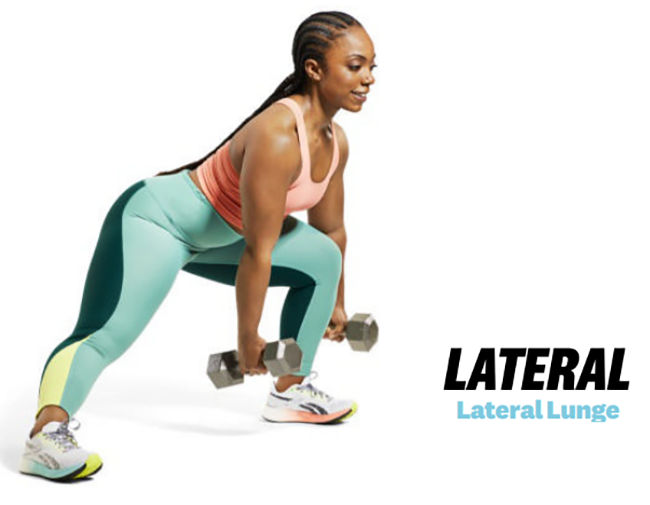
LATERAL ▶ LATERAL LUNGE


HOW TO: Stand with feet hip-width apart, a DB in each hand (not pictured). Step left foot out to left, landing with left hip hinged back, left knee bent and in line with ankle, right leg extended, weights on either side of left knee. Drive through left heel and engage glutes to return to start. Repeat on opposite side.


CARRY ▶ FARMER'S CARRY


HOW TO: Stand tall with a DB in each hand at sides, palms facing in. Squeeze shoulder blades together and engage core and glutes, then walk forward for several steps without letting the weights swing. Pause, then turn and walk back to start.

When you find yourself looking for a little relief, read this first to see if these buzzy bottles are worth a shot. You’re likely familiar w...

ANTI-BLOAT SUPPLEMENTS ANTI-BLOAT SUPPLEMENTS


When you find yourself looking for a little relief, read this first to see if these buzzy bottles are worth a shot. You’re likely familiar with the feeling of rushing to unbutton your pants after a big dinner or at the end of a long day of period puffiness. Bloating—a pretty universal conundrum, let’s be real—is why anti-bloat supplements from brands like HUM, Arrae, and The NueCo. entered the wellness ring. While the ingredients vary from productto product,these oral supps are generally packed with a blend of digestive enzymes and herbal ingredients (dandelion root, ginger,to name a couple)that are said to aid digestion and promote a healthy gut and, in turn, reduce the swell. Sounds attractive, but can they really deliver on the promises? What experts say aboutthese offerings...


They can nix painful gas and bloating.


TRUE!


Your gut is like a long hose lined with smooth muscle, which becomes stretched when your intestines expand from excess gas, says NYC gastroenterologist and WH advisor Samantha Nazareth, MD.Some ingredients, such as fennel and peppermint, can relax muscles and aid in moving food and air along, easing discomfort. So they may help after a meal or a night out, for example, and are generally safe if used as directed. These remedies aren’t must-haves, though—sometimes a lifestyle tweak (like slowing down when you eat) does the trick.


They help calm heartburn


POSSIBLE.


Ananti-bloat supp might work if the burn is a result of food not being digested properly, says Dr. Nazareth. If you ate a lot and the foodis taking a long time to break down, that can prevent the valve connecting the esophagus and the stomach from closing properly—allowing acid and contents to flow back. In these cases, digestive enzymes and herbs can help the issue. But there are other possible causes of heartburn unrelated to digestion, such as a hiatal hernia and pregnancy.Consu your MD first to rule out other reasons.


They give your gut a boost.


FOR SOME, YES.


These supplements cankeepyour system running smoothly if you tend tohave trouble digesting certain eats.Choose a tablet with enzymes that specifically target the culprit. For example, if fats are the source of your woes, you’ll want one with lipase. One note: It’s hard to tell if you’re getting the therapeutic dose because de-bloat supps (or any) are not FDA regulated. “I encourage people to do their own research into a company,” says Marvin Singh, MD, a California-based integrative gastroenterologist. Look at their track record online and research the manufacturer, product, and ingredients.


FYI: If you have a blood disorder, you’ll want to avoid a formula that includes bromelain. It works on proteins but can also interfere with platelets and clotting. Ultimately,for awell-functioning gut, go back to basics: eating a well-balanced diet, managing stress, and prioritizing sleep. “Those are fundamentals for everybody, ”Dr. Nazareth says .Good reminder!