Subscribe Us

Responsive Advertisement

Not thrilled by running or cycling? Here are four overlooked forms of cardio exercise you might not yet have considered. With physical activ...

FUN WAYS TO GET FIT  FUN WAYS TO GET FIT

Not thrilled by running or cycling? Here are four overlooked forms of cardio exercise you might not yet have considered.

With physical activity guidelines recommending we do 150 minutes of moderate-intensity activity (that which raises your heart rate a little), cardiovascular exercise is hard to swerve. But if you’re not wowed by the repetitive nature of going for a run, hike or ride, there are other options. Indeed, many people find their fix with team sports, interval training or even lifting weights in short bursts. But increasingly, throwback-style, playground-inspired activities have come to the fore as a popular way for adults to hit their cardio goals. The bonus? They’re a great way to stay active as a family, too. Why not give these four workouts a go this autumn?


SCOOTING


You might be used to standing on the sidelines while the kids whizz about on scooters, but scooting provides fitness benefits for all ages. As a low-impact but full-body form of exercise, it’s easy on your joints, great for cardiovascular health and simple to get to grips with. It provides a handy source of core conditioning, as well as building muscular endurance, and a speedy way to nip to the shops. Data shows you could burn up to 480 calories an hour on a scooter, but we reckon you could up that if you try to speed-scoot uphill! 


ROLLERSKATING


Head outside and get your endorphins flowing with rollerskating, for a fun activity that will hark right back to your childhood. It might take a bit of practice, but all of the balancing required while propelling your body forwards means you engage a whole host of muscles and get a really good workout. Skating is a great way to work your glutes, hamstrings, calves and inner thighs, but you’ll also find it provides a form of mindfulness, as you have to focus on your movements and staying balanced. There are lots of ways to do it – rollerskating, rollerdance, at a skatepark – but a typical one-hour ride on flat ground at a beginner level will burn up to 700 calories. Wow.


REBOUNDING


This trampoline-based form of exercise made a resurgence during the lockdowns, with many finding it to be a home-friendly way to keep fit. The mat of a mini trampoline is more taut than that on a bigger trampoline, which makes it a more focused workout for your core. Indeed, with the right technique, experts report that your workout will be three times more effective than the same moves done on the floor, thanks to the addition of gravity and G-force. It’s a low-impact (the trampoline mat absorbs 87 per cent of impact) and high-cardio form of exercise that will raise your heart rate, burn fat and boost your coordination. What’s not to love? 


HULA HOOPING


Get a little bit nostalgic by grabbing a hula hoop and revving up your heart rate. The secret to hula hooping success is to find an adult-sized hula and maybe even opt for a weighted one for an additional strength challenge. Requiring a lot of shimmying from your hips and waist, hula hooping is a great (and expressive) way to work your core. It will also boost your cardiovascular system and fire up the smaller muscles of your upper back, glutes and legs, plus you can get creative by squatting or moving around as you hula. It’s great for fat burn, too – a half-hour of hula hooping is said to burn up to 165 calories.

This fusion-style workout includes a series of cardio moves and Pilates-inspired exercises, which will hit every muscle in your body in less...

TOTAL BODY BLITZ  TOTAL BODY BLITZ

This fusion-style workout includes a series of cardio moves and Pilates-inspired exercises, which will hit every muscle in your body in less than 30 minutes.


Pilates is a form of exercise that concentrates on strengthening the body, with an emphasis on core strength, posture, balance and flexibility. High-intensity interval training (HIIT), n the other hand, is a form of exercise that raises the heart rate and improves cardio fitness. So, what happens when you combine the two together?


You get “Pilates HIIT”, a workout that mixes short bursts of intense activity with more controlled, low-intensity movements. These allow your heart rate to come down whilst you’re still moving mindfully and dynamically, and working the body to its maximum potential. It’s a great way to burn fat and increase fitness whilst improving flexibility, balance and core strength.


This workout is designed for those who love the idea of Pilates but want a quick and effective session that achieves a genuine result. If you’re short on time, this 25-minute workout will leave you sweaty and shaky, and feeling like you’ve had a creative workout. Fitness is about finding that balance, where you’re working hard enough to feel physically hallenged but still feel connected and mindful about what you’re doing.


HOW TO DO IT


These three circuits alternate between standing, high-intensity exercises and low-intensity Pilates mat moves. Complete one circuit, have a drink of water then do the next one. Repeat the whole workout three times through. 


CIRCUIT 1 - HIIT MOVE: SIDE STEP TO FLOOR TAP


Reps: 30-45 seconds


• Stand on your mat and take a big side-step to curtsy the left leg behind the right.

• Touch the floor with your left hand (A), then stand back up into a star shape (B) and repeat on the opposite side (C).

• Keep stepping from side to side, or pick up the pace by adding a light skip across the mat to make it quicker. Make sure you bend your knees to get low in the curtsy, and engage your core as you move.


CIRCUIT 1 - PILATES MOVE: CRISS-CROSS OBLIQUES


Reps: 30-45 seconds


• Lie down on your mat and bend your knees into a tabletop position. Curl your head up, taking your hands behind your head.

• Inhale to prepare and, as you exhale, pull the left knee in while rotating the right elbow towards it (A).

• Switch sides (B) and continue alternating, taking short exhales as you switch. Try not to pull on the back of the neck – think about bringing the armpit to the knee rather than the elbow – and aim to keep your pelvis stable.


CIRCUIT 2 - HIIT MOVE: JUMP SQUAT


Reps: 30 seconds


• Place your feet in a wide stance and turn your toes out slightly. Hold two dumbbells at chest-height (you can do this without weights if you prefer).

• Bend your knees to squat down, keeping your core engaged (A).

• Push off the ground to propel your body into the air (B). Land in the squat position and jump back into he air.

• To make it easier, don’t jump and instead extend your legs to return to standing, squeezing your bottom as you stand.


CIRCUIT 2 - PILATES MOVE: SINGLE-LEG BRIDGE WITH LEG PULL


Reps: 45 seconds (each leg)


• Lie on your back with your knees bent and your feet hip-width apart, arms by your sides.

• Inhale to prepare and, as you exhale, draw your abdominals in and lift your hips up into a bridge position.

• Lift one leg to the ceiling (A). Inhale to draw that leg down, so that it’s level with the bent knee, foot flexed (B).

• Exhale to point the toes and kick the leg straight back up to the ceiling.

• Repeat 5-10 reps on one leg, then switch legs to repeat and continue alternating. Keep your hips lifted, tuck your tailbone under, and engage your bottom and tummy to reduce any pressure in the lower back.


CIRCUIT 3  - HIIT MOVE: BACKWARDS LUNGE TO KNEE-LIFT


Reps: 30 seconds (each leg)


• Stand with feet hip-width apart and a dumbbell in each hand. Lunge backwards by taking a big step back with one foot and lowering the back knee towards, but not touching, the floor (A).

• Return to the starting position, taking the weights out in front of you and the back knee to hip-height (B).

• Lunge back as you lower the weights, repeating the move on the same leg. Continue for 30 seconds, then switch sides. 


CIRCUIT 3 - PILATES MOVE: KNEE-TO-CHEST TO DOWNWARD DOG


Reps: 30-45 seconds


• Start in high plank your feet hip-width apart. Engage your core, bottom and legs, and draw your shoulders down.

• Lift the right foot up and draw the right knee underneath you towards your chest, toes pointing (A).

• Return the foot back down and then send your tailbone to the ceiling, into a downward dog position (B). Stay high on your toes and focus on the stretch through your hamstrings and upper back/shoulders.

• Return to plank and repeat on the other side, then continue alternating.


If you think calorie counting is such a waste of time, Iwhat do I do instead? How do I prevent myself from eating too much? How do I stay at...

STOP COUNTING CALORIES AND 11 THINGS TO DO STOP COUNTING CALORIES AND 11 THINGS TO DO

If you think calorie counting is such a waste of time, Iwhat do I do instead? How do I prevent myself from eating too much? How do I stay at the same weight, year after year? The answer is simple.


6 REASONS TO STOP COUNTING CALORIES


1. Labels can lie


Yes. Labeling laws allow a 20% margin of error on the nutrition facts panel. That means your 100-calorie snack pack could be 119 calories. Or that 500-calorie TV dinner could be nearly 600 calories.


"The ratio between the amount obtained by laboratory analysis and the amount declared on the product label in the Nutrition Facts panel must be 120% or less, i.e., the label is considered to be out of compliance if the nutrient content of a composite of the product is greater than 20% above the value declared on the label."


2. Nutrients vary by season, variety, ripeness, etc.


While it’s nice to have the nutrient analysis of foods, there is no way food companies could analyze every variety of tomato from every region from every season from different growing conditions (i.e. organic vs. conventional) and every other variable for nutrients, including calories.


For e.g. super sweet summer tomato likely has more calories (and valuable nutrients) than that tasteless, pink one from the dead of winter. Which one would you rather eat?


3. "More calories equals weight gain" is not an exact science.


If calorie counting worked long-term, the USA would be the thinnest country in the world. We are a nation of compulsive dieters and you wouldn’t know it looking at us. The composition of what you’re eating is crucial to how many calories you eat and how many calories you burn.


In a comparative study of 3 diets: low-fat, low-glycemic, and lowcarb. It was observed that those on the low-carb diet burned 350 calories more than the low-fat diet. And yet, our nutrition guidelines recommend a low-calorie, low-fat diet. Trouble is, when you focus on calories, you’re likely to eat less fat (since fat is more calorie-dense than carbohydrate and protein). And when you eat less fat, you’re likely to eat more carbohydrates. See the problem?


If you’re happy eating tasteless, low-fat food, going hungry, and not losing weight, by all means, count calories and cut fat out of your diet."


4. We don’t absorb all calories.


It’s true! A study on almond consumption in humans found that up to 20% of the calories were not absorbed. (J Agric Food Chem, 2008) The exact reason is unknown, but possibly due to the “cellular structure” of nuts and the way our bodies digest food.


In summary, a calorie is not necessarily a calorie: given the functional differences between edible plants, interfamily and even interspecies differences must be considered when making comparisons between food processing techniques.


There’s good evidence that our gut health (and gut bacteria) plays a role in how many calories we absorb from our food.


5. Focusing On Calories Often Means We Restrict Healthy Foods.


This especially happens when it comes to fat. We often omit higher fat foods simply because they are higher in calories without taking into consideration what benefits we might get from them, such as staying fuller for longer (hungry), absorbing antioxidants from vegetables, and getting necessary nutrients, like fat-soluble vitamins.


(This is crucially important for pregnant women who may become deficient in key brain-building nutrients if they restrict fat.)


Choose to fully ignore calorie labels, especially on real foods that are naturally high in fat such as meat, fish, eggs, cheese, butter, avocados, olives, nuts, and seeds. There are innumerable benefits to eating them, and you cannot end up overeating every time


6. Too Much Math.


Honestly, NO one has the time or energy to calculate everything that goes into one’s mouth. That probably sounds odd, but this can be done and is best done without counting. Counting calories is especially fruitless when you know #1-5


11 THINGS TO DO INSTEAD OF COUNTING CALORIES


1. I listen to my body.

2. I always eat when I’m hungry.

3. I eat foods that I’m actually in the mood to eat.

4. I put my full attention on the meal in front of me.

5. I notice the sensations in my body before, during, and after eating.

6. I sit down when I eat.

7. I chew every bite before taking another.

8. I savor the flavors, texture, mouth feel, sounds, richness, crunchiness or softness, saltiness, or sweetness.

9. I make an effort to eat healthy foods and make an equal effort to eat the healthy foods that taste good to me.

10. I sometimes choose to eat foods purely for the pleasure of eating them, even when they are not “healthy”.

11. I sometimes choose to eat more food than is comfortable, either because the food tastes really good or because I know I won’t have time to eat again for a while (such as during a busy work day).

It’s frustrating: You’ve been working to build healthier habits but aren’t seeing a boost in energy or confidence. The truth is, your daily ...

SEVEN HABITS THAT MAY BE UNDOING YOUR HARD WORK SEVEN HABITS THAT MAY BE UNDOING YOUR HARD WORK


It’s frustrating: You’ve been working to build healthier habits but aren’t seeing a boost in energy or confidence. The truth is, your daily efforts might not be as helpful as you hoped. Check your routine for the following traps.


1. EATING TOO LITTLE 


In the truest sense, calories equal energy. And if you’re restricting calorie intake too much, your body lacks essential fuel.


In fact, when you significantly restrict calories, your systems don’t have enough energy to perform their most essential functions. Instead, the body adapts and tries to conserve energy, slowing down your metabolism in the process. This can lead to feeling sluggish, unfocused and even unmotivated.


While being mindful of your calorie intake, you should home in on nutrient-dense calories so your body gets everything it needs to run like a welloiled machine.


Nutrient-dense calories will fill you up with goodfor-you vitamins, minerals, fats and other must-haves so you can keep your body properly fueled and operating at its best.


Additionally, instead of cutting back on calories, try incorporating more foods that’ll satiate your hunger and help you feel fuller for longer periods of time. Filling foods deliver those much-needed, energy-generating calories without leaving you hungry or unsatisfied. One of the best options? Protein! Protein powers nearly every one of your body’s systems, from cell repair to strengthening muscle. And it’s as filling as it is beneficial.


2. RELYING ON "DIET" FOODS


It’s counterintuitive (and maddening), but the bulk of convenient “diet” foods, low-calorie snacks, meals and even meal-replacement products are far from ideal choices for anyone trying to eat clean. These foods, which include items that claim to be low-fat, low-calorie and even helpful for weight loss, are typically loaded with additives.


These processed products often feature sugar or sugar alcohols to enhance their flavor – just take one sixounce container of low-fat vanilla yogurt, which contains a whopping 23.5 grams of sugar (hint: always opt for plain, unsweetened).


And there’s another sneaky little detail hiding among the low-fat, lowcalorie “diet” foods: Often, these products don’t fill you up or keep you satisfied for any length of time. As a result, this could lead to some unintended and not-so-smart snack choices.


Instead of reaching for rocessed diet foods, fill your plate and your pantry with nutrient-dense whole foods. These items offer a high dose of vitamins, minerals and other necessary nutrients that deliver energy and an overall sense of vibrance and good health. Nutrient-dense foods like brown rice, baked potatoes, salmon, lean cuts of beef and plain Greek yogurt are always better alternatives to packaged and convenient products.


3. EXERCISING WRONG


Having a workout plan benefits both your physical and mental health. Breaking a sweat regularly helps strengthen your heart, build muscle, protect your bones, grow new brain cells and even boost endorphins, those feel-good chemicals that help enhance mood and encourage a sense of well-being.


But sticking with just one form of exercise and performing it over and over again isn’t the best route to take. Instead, change it up and keep your body on its toes. Rather than just relying on aerobic exercise, add interval training — these short bursts of intense activity burn more energy while preserving lean muscle mass. Incorporate resistance training and weight lifting to build muscle and prevent a decrease in metabolic rate. Then bask in the rush of endorphins.


4. NOT GETTING ENOUGH ZZZs


If you aren’t getting a good night’s sleep every night of the week, it’s hard to get through the day, let alone think about healthy habits. Skipping out on the hours of shut-eye your body needs has a variety of negative effects, not the least of which is a sluggish brain (and jangled neurotransmitters). In the simplest terms, this means your body isn’t able to burn energy as efficiently and you can’t think as clearly. Over time, these inefficiencies can add up to increased mental and physical stress.


Studies have shown that those who adhere to a Mediterranean-style diet (rich in fruits, vegetables, whole grains, fish, nuts and seeds) sleep longer and enjoy a more restful slumber. The reason? Many of those foods naturally contain high levels of melatonin, seratonin and vitamin D — all hormones that play a role in sleep.


In addition to fueling your body with the best possible foods, do your best to stick to a set sleep schedule. Going to bed and waking up at the same time each day is a building block for healthy living.


5. MISSING OUT ON FUNCTIONAL NUTRIENTS


If you aren’t getting enough of the right nutrients, you could be sabotaging yourself. Without functional nutrients, or the nutrients that promote optimal health, your body can’t run at its best. And that’s where nutrient-dense foods come in.


Nutrient density is an eating concept that goes beyond judging a food by its calories alone. Instead, you focus on the nutrients – or the nutrients per calorie. The more nutrients packed into a single food calorie, the more beneficial it is.


Just take broccoli, for example: A one-cup serving contains just 31 calories, but you’re also getting a ton of vitamin C and vitamin K, making it a nutrient-dense food. Whole grains are another great example. Calorie for calorie, whole grains offer a broader spectrum of vital nutrients than their refined counterparts.


And research suggests that consuming more nutrient-dense foods is key to overall health. The act can promote longevity and lower the risk for some of today’s biggest killers like heart disease.


In addition to nutrientdense foods, it’s also important to ensure you aren’t overlooking protein or fiber. A lack of protein is particularly troublesome because getting the right amount helps preserve muscle while boosting your metabolism and overall energy.


Fiber, on the other hand, helps satiate hunger – it can even help you maintain a healthy weight naturally. Fiber-rich foods and meals help fill you up quickly, which may influence how much you eat (and what you choose to eat at later meals).


6. STRESSING OUT


High levels of cortisol, one of the body’s primary stress hormones, can stymie even the best intentions. When you’re stressed, your body’s fight-or-flight response is triggered and the production of stress hormones amps up.


The problem: Chronic stress and high levels of cortisol prompt the body to seek out energy-dense foods, especially those rich in sugar and fat. While these foods might ease stress in the short term, they leave you feeling, well, not your best.


Constant tension and anxiety can also impact sleep, and research links sleep disturbances with a higher risk of diabetes and other diseases. To keep cortisol in check, get at least eight hours of sleep a night and exercise daily. To lessen stress, try meditation, deep breathing, yoga or safe, tension-taming herbs and supplements.


7. OBSESSING OVER THE SCALE


There is nothing good (mentally, physically or emotionally) about being tied to a number on the scale. It’s nerve-wracking and, most importantly, not a true indicator of how healthy you are.


Focusing too heavily on your weight can hamper your efforts for better overall health and wellness. Staring at the scale can actually distract you from bodily cues, preventing you from paying attention to important signals like hunger, stress and exhaustion. It’s better to eat mindfully, feeding your body when it signals it’s hungry and stopping when you’re full. No scale can reflect those key clues.


In truth, your weight and clothing size are very poor indicators of how healthful your lifestyle and diet are. The number on the scale is just that – a meaningless number.


So, banish the scale and look at “good health” through a wider lens, one that offers more opportunities to rejoice. This is the benefit of nurturing habits that nourish the body through energy-rich foods, a regular exercise regimen and a tried-and-true sleep routine.

This workout hits every movement pattern and muscle group. Do it up to three days a week. Once comfortable, swap in other must-do moves list...

FULL-BODY STRENGTH EXERCISES FULL-BODY STRENGTH EXERCISES

This workout hits every movement pattern and muscle group. Do it up to three days a week. Once comfortable, swap in other must-do moves listed in each category to keep the gains great and the workouts fresh. Instructions: Using a pair of mediumto heavy dumbbells, do the following moves ino rder (push, pull, hinge, squat, then bonus patterns) for 30 to 45 seconds each, with 10 to 15 seconds of rest in between. Do three or four total sets.


PUSH ▶ SHOULDER TAP TO PUSHUP


HOW TO: Begin in a high plank position with hands slightly wider than shoulders, legs extended(A). Keeping back flat and hips square with floor, tap right hand to left shoulder(B),then repeat with left hand to right shoulder. Return to high plank, then bend elbows and lower chest toward floor(C). Press up to return to start.


HINGE ▶ ROMANIAN DEADLIFT


HOW TO: Stand with feet hip-width apart, holding DBs close to body by hips, palms facing in(A), keeping spine long, send hips hacks with control as you hinge forward at waist. Keeping DBs close to body, lower weights to shins, or as far down as you can without curving spine (B). Pause, then reverse movement to return to start, engaging glutes and core at top.


PULL ▶ GORILLA ROW


HOW TO: Stand with feet wider than hips and place DBs between feet. Keeping spine long, bend knees and lower hips to grasp DBs with palms facing in, arms extended(A). Lift one weight off floor toward rib cage (B), then slowly lower it back down. Repeat with other arm.


SQUAT ▶ GOBLET SQUAT


HOW TO: Stand with feet slightly wider than hips,holding one DB vertically in both hands at chest height. Elbows should be close to rib cage (A). Bend knees and lower hips into a squat, keeping chest upright (B). Pause, then drive through heels and glutes to stand.


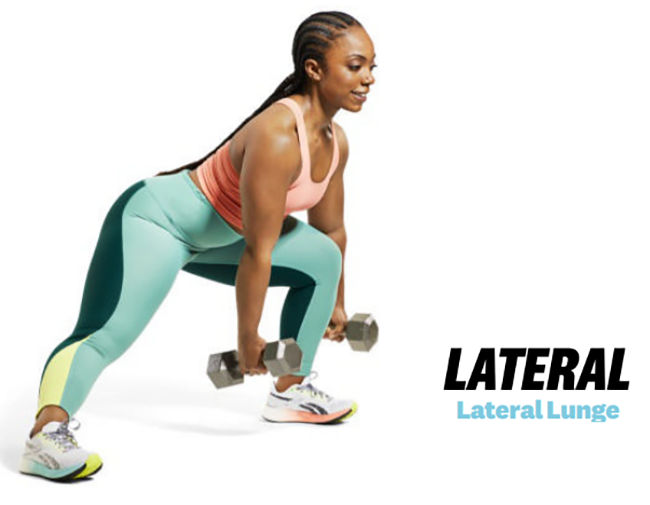
LATERAL ▶ LATERAL LUNGE


HOW TO: Stand with feet hip-width apart, a DB in each hand (not pictured). Step left foot out to left, landing with left hip hinged back, left knee bent and in line with ankle, right leg extended, weights on either side of left knee. Drive through left heel and engage glutes to return to start. Repeat on opposite side.


CARRY ▶ FARMER'S CARRY


HOW TO: Stand tall with a DB in each hand at sides, palms facing in. Squeeze shoulder blades together and engage core and glutes, then walk forward for several steps without letting the weights swing. Pause, then turn and walk back to start.

When you find yourself looking for a little relief, read this first to see if these buzzy bottles are worth a shot. You’re likely familiar w...

ANTI-BLOAT SUPPLEMENTS ANTI-BLOAT SUPPLEMENTS


When you find yourself looking for a little relief, read this first to see if these buzzy bottles are worth a shot. You’re likely familiar with the feeling of rushing to unbutton your pants after a big dinner or at the end of a long day of period puffiness. Bloating—a pretty universal conundrum, let’s be real—is why anti-bloat supplements from brands like HUM, Arrae, and The NueCo. entered the wellness ring. While the ingredients vary from productto product,these oral supps are generally packed with a blend of digestive enzymes and herbal ingredients (dandelion root, ginger,to name a couple)that are said to aid digestion and promote a healthy gut and, in turn, reduce the swell. Sounds attractive, but can they really deliver on the promises? What experts say aboutthese offerings...


They can nix painful gas and bloating.


TRUE!


Your gut is like a long hose lined with smooth muscle, which becomes stretched when your intestines expand from excess gas, says NYC gastroenterologist and WH advisor Samantha Nazareth, MD.Some ingredients, such as fennel and peppermint, can relax muscles and aid in moving food and air along, easing discomfort. So they may help after a meal or a night out, for example, and are generally safe if used as directed. These remedies aren’t must-haves, though—sometimes a lifestyle tweak (like slowing down when you eat) does the trick.


They help calm heartburn


POSSIBLE.


Ananti-bloat supp might work if the burn is a result of food not being digested properly, says Dr. Nazareth. If you ate a lot and the foodis taking a long time to break down, that can prevent the valve connecting the esophagus and the stomach from closing properly—allowing acid and contents to flow back. In these cases, digestive enzymes and herbs can help the issue. But there are other possible causes of heartburn unrelated to digestion, such as a hiatal hernia and pregnancy.Consu your MD first to rule out other reasons.


They give your gut a boost.


FOR SOME, YES.


These supplements cankeepyour system running smoothly if you tend tohave trouble digesting certain eats.Choose a tablet with enzymes that specifically target the culprit. For example, if fats are the source of your woes, you’ll want one with lipase. One note: It’s hard to tell if you’re getting the therapeutic dose because de-bloat supps (or any) are not FDA regulated. “I encourage people to do their own research into a company,” says Marvin Singh, MD, a California-based integrative gastroenterologist. Look at their track record online and research the manufacturer, product, and ingredients.


FYI: If you have a blood disorder, you’ll want to avoid a formula that includes bromelain. It works on proteins but can also interfere with platelets and clotting. Ultimately,for awell-functioning gut, go back to basics: eating a well-balanced diet, managing stress, and prioritizing sleep. “Those are fundamentals for everybody, ”Dr. Nazareth says .Good reminder!

Don’t turn your back on pasta, potatoes, or peas just yet—new research shows they may actually be the key to improving your health while she...

THE SURPRISING BENEFITS OF STARCH TO IMPROVING YOUR HEALTH WHILE SHEDDING FAT THE SURPRISING BENEFITS OF STARCH TO IMPROVING YOUR HEALTH WHILE SHEDDING FAT


Don’t turn your back on pasta, potatoes, or peas just yet—new research shows they may actually be the key to improving your health while shedding fat. 


Feeling pretty good about cutting out pasta, potatoes, and other starchy fare from your diet? Not so fast: Research shows you may actually be missing out on a slow of health benefits including a sleeker physique. 


That’s because all high-carb foods are not created equal. Some are rich in resistant starch, which actually promotes weight loss, plus a whole lot more.


Resistant starch is a type of fiber found in certain plant foods, including beans, corn, and bread. As the name implies, this starch “resists” digestion in the small intestine, which prevents your body from absorbing the calories it contains. By the time resistant starch makes its way to the colon, specific types of good bacteria feed on it to produce short-chain fatty acids, including butyrate (more on that below).


IT TORCHES FAT: Studies done with both humans and animals show that a diet rich in resistant starch decreases body fat. Here’s how: While most of the butyrate produced from resistant starch remains in the colon to support gut health, some of the short-chain fatty acids also travel to the liver, where they prevent the organ from releasing stored carbohydrates into the bloodstream, prompting the body to burn body fat for energy instead.


IT STEADIES ENERGY LEVELS: Foods with resistant starch help slow the rise of blood glucose levels after eating, providing long-lasting energy. Other carb-rich foods like crackers, chips, and cookies are quickly digested, resulting in sharp spikes in blood glucose that must be reduced with insulin. Keeping blood glucose within normal limits is important in the long run because it reduces wear and tear on your body. The more often the pancreas is called upon to produce insulin, the greater the risk of type-2 diabetes over time.


IT’S HEART-HEALTHY: Reduced blood glucose levels also contribute to stronger arteries that allow greater blood flow to the heart and the extremities.


Resistant starch helps lower levels of artery-clogging cholesterol and triglyceride (fat) levels in the blood, which maximises the flow of blood and nutrients to your heart, brain, and working muscles.


IT TAMES HUNGER: Animal studies suggest that resistant starch prompts  the production of certain hormones that shut off hunger, so you feel satisfied while eating less. In addition, resistant starch takes longer to digest than other types of carbohydrates, and it promotes feelings of fullness for hours after eating. Just make sure to keep your meals balanced: One study in particular found that women  who combined protein with resistant starch at the same meal felt fuller, had greater eating satisfaction, and burned more body fat than women who ate either protein or  resistant starch.


IT’S GOOD FOR YOUR GUT: Butyrate produced from resistant starch provides energy for the cells in the colon that keep the lining of the gut in shape and help the body to dodge ailments like colon cancer and irritable bowel disease (also known as IBD). But yrate is also a food source for the trillions of healthy bacteria that live in your gut. Higher levels of good gut bacteria are linked to a stronger immune system, reducing risk for infection.


EAT THIS: Legumes (black beans, garbanzo beans, pinto beans), white and sweet potatoes, underripe bananas, pasta, and all kinds of rice are among the top whole-food sources of resistant starch. Some packaged foods contain Hi-maize, a commercial, corn-based resistant starch powder. Check the ingredient list for foods with constarch, resistant cornstarch, or Hi-maize, which is also packaged as a flour replacer. The starch is useful when making baked goods; you can swap as much as one-third of the flour in recipes for the brand.


Be aware: Too much suplemental resistant starch may interfere with the absorption of other nutrients, and it could make you gassy, which is almost never a good thing. Instead, focus on whole foods, which also include plenty of vitamins, minerals, and phytonutrients.


PREP NOTES: How you prepare these foods can also have an effect on how much of the starch you’re consuming. Cooked and cooled versions of grains, as well as vegetables like legumes and potatoes, provide significantly more resistant starch than when these foods are cooked and still warm. That's because cooling will transform digestible starch to resistance starch—a process called retrogradation. Your body is unable to fully digest the resistant starch or use it for energy, so the calorie count naturally decreases, which is a similar principle to net carbs. When researchers from the College of Chemical Sciences in Sri Lanka cooked white rice with a hit of coconut oil and chilled it for 12 hours, it increased the amount of resistant starch tenfold while cutting calories by about half. But there’s no need to eat your dinner cold: Reheating rice doesn’t change the resistant starch concentrations.

  Exercise is only half the battle. Use this eating plan alongside your workout to double your fat loss without missing any muscle-building ...

THE SHOTGUN SIX-PACK DIET THE SHOTGUN SIX-PACK DIET


Exercise is only half the battle. Use this eating plan alongside your workout to double your fat loss without missing any muscle-building nutrients. You’ll excavate those abs quicker than ever.

#1. Greens

Loaded with vitamins, greens will balance out your hormones and transfer protein right where it’s needed.

Morning
-3 esparagus spears
Lunch
-2 handfuls spinach
Afternoon
-2 handfuls broccoli
Evening
-1 handful kale
Before Bed
-500ml greens drink

#2. Protein

To compensate for the calorie deficit you’re creating, you need a lot of protein. Split it across the day and aim for 1g per 0.5kg of your bodyweight. Below is a breakdown for the average 80kg man.

Morning
-3 boiled eggs
Lunch
-2 chicken breast
Evening
-1 rump steak
-1 handful kidney beans
Any time
-1 protein shake
Total protein
160g

#3. Fats

Fat doesn’t actually make you fat. Refined carbs are to blame for the lodge around your middle. Healthy fats fuel your training, encourage muscle growth and, crucially, teach your body to burn fat for energy.

Morning
-1 handgul cashews
-1 tsp coconut oil
Lunch
-1 avocado
Evening
-1/2 handful mozzarella
Before Bed
-1tbsp almond butter
Total fats
83g

#4. Carbs

Yes, you need to cut back on these to build six-pack abs, but most of the carbs you do put away you’ll eat before bed. That’s right: this improves sleep quality and recovery, reducing cortisol and body fat. Here’s what you should tuck into each day.

Morning
-Handful blueberries
Lunch
-1 banana
Evening
-Large spoon sweet potato mash
-1 apple
Total carbs
123g

Chronic stress and anxiety signal the brain to wreak havoc on your body. The secret to hitting reset? Yoga. One in 16 young Australians is c...

TRAIN YOUR BRAIN TO RELAX TRAIN YOUR BRAIN TO RELAX

Chronic stress and anxiety signal the brain to wreak havoc on your body. The secret to hitting reset? Yoga. One in 16 young Australians is currently experiencing depression, one in six young Australians has an anxiety condition, and one in four young Australians currently has a mental health condition. In America, nearly 40 million people have been diagnosed with anxiety disorders. And while not all of us suffer the intense level of stress and anxiety that many, we’re not immune to the symptoms. For instance, nearly 75 percent of respondents in a 2o14 American Psychological Association Stress in America survey reported stress-related symptoms, such as nervousness and irritability, because of money. Stress and anxiety aren’t necessarily bad things,  but when they persist for weeks on end they can lead to increased heart rate and blood pressure, muscle tension, lingering restlessness, insomnia, panic, and depression. And over longer periods of time, stress and anxiety have been linked with infl ammation, which researchers correlate with migraines, cardiac issues, and even cancer. 


Though they have some distinct differences, both stress and anxiety represent varying degrees of nervous-system imblance. Stress is defined as a reaction to a life event that disturbs a person’s physical and mental equilibrium: someone who is stressed out might become edgy or overwhelmed by sitting in traffic or thinking about their workload. Anxiety, also part of everyday life, is not necessarily event driven.


The catalyst for both stress and anxiety is a primal, hardwired neurological response to a potential threat. When something presents a challenge, whether it’s an event, memory, or a general sense of shouldering the weight of the world, your sympathetic nervous system—the nerves that control your ‘fi ght or fl ight’ response—sends signals to your brain to fl ood your body with stress hormones such as adrenaline and cortisol. These shorten your breath, fi re your muscles, sharpen your focus, and jolt you into action. That’s normal, and helpful if you, say, happen to come across a black snake on a remote trail, or are a sprinter at the starting blocks. But when you remain in a heightened stress state—for example, when you have to take care of a sick loved one for months or years—the potential health consequences start to add up.


So how do you regain balance? A growing body of research shows that practicing mindfulness and breathing more slowly can tame sympathetic activity and balance the nervous system. “When you take a deep breath, you tell the body to relax”. Slow, mindful breaths activate the parasympathetic nervous system—the sympathetic nervous system’s counterpart. When the breath slows, the parasympathetic nervous system in turn slows the heart and sends a relaxing message to the nerves, inspiring a ‘rest and digest’ response. Several yogic tools encourage us to slow our breathing and stay present, including gentle asana; meditation; some pranayama (breathwork); and rest in the form of Savasana (Corpse Pose) and yoga nidra, or ‘yogic sleep’.


KEEP CALM & CARRY ON


Mindful Yoga Therapy was developed to aid returning military service members suffering from PTSD, but a version of this same practice can help us all develop the skills to better manage stress and anxiety. Because these conditions may manifest themselves differently in every body, it is important to remember that the following sequence isn’t a cure-all; it’s simply one way to find some peace of mind. Practice these poses, designed to access the parasympathetic nervous system, with a soft, steady Ujjayi breath—breathing in and out through the nose with an ocean-like sound—with equal inhales and exhales and a relaxed face. Both breath and asana will help you stay in the present moment and counter the great deal of pain and anxiety that can arise when thinking about the past and future. Practice as many times a week as you can and you’ll start to see a shift in the way you react to stress.


When that happens, I’m so happy. They are in such need of rest and peace.” For your own slice of serenity, take a break from life’s stressors and try the calming Mindful Yoga Therapy sequence on the following steps.


1. Constructive Rest


Lie on your back with your knees bent and your feet on the floor hip-distance apart. Allow your knees to rest together. Close your eyes or lower and soften your gaze. Simply observe your breath as an exploration: it may feel deep and rich or it may feel shallow and light—there is no right or wrong. Just allow the breath to wash through you, nourishing your cells, tissues, and organs. If it feels appropriate, you can focus on one specific area that may be troublesome (a tense shoulder, for example). As you bring your focus to this area, treat your awareness as if it were a sponge: every time you inhale, the sponge brings in fresh, new oxygen that washes through you and when you exhale it sends out anything unneeded or unwanted. Then take a moment to think about one thing you are grateful for, and use that to set an intention for your practice. Take as much time here as needed. 


2. Supine Twist


Draw your knees in toward your chest, place your right hand on your left knee, and extend your left arm straight out to the left. Inhale, and as you exhale, roll your knees to the right. Take 3 to 5 breaths here. Inhale and draw your knees back to centre, and exhale as you squeeze them back in toward your chest. Inhale and reach for your right knee with your left hand. Extend your right arm out to the right and exhale your knees to the left. Take 3 to 5 breaths here. Inhale and bring your knees back to centre; squeeze in one more time. Exhale and release your feet to the earth. When you reach through your extended arm, you are wisting deeper and bringing more breath into the lungs. This pose is also effective at relieving tension in the lower back, where many of us carry stress.


3. Hands and Knees Balance


When you’re ready, roll to one side to sit up and come to your hands and knees. Place your hands slightly in front of your shoulders, and your knees directly under your hips. Bring your attention to your hands, allowing them to press into the earth. Let this keep you grounded and present. Softly bend your elbows. As you continue pressing, connect with the earth, seeing if you can feel the rebound of that connection all the way up through your body and to your tailbone and sitting bones. This pose helps to ground you, allowing you to trust the earth to support you. Next, imagine that you have your hand on your navel, supporting you from the underside of your body. Lightly lift your core up and in. This is called ‘navel support’ and allows the spine to be long and supported, protecting and strengthening your lower back. Try to maintain this support throughout your practice. Inhale and raise your right arm and left leg into Hands and Knees Balance; now reach the two limbs in opposite directions. Navel support and the grounding of the opposite hand and leg pressing into the earth should keep you steady and even. Remain here for 5 breaths, and then exhale as you draw your extended arm and leg back down to the earth. Repeat on the other side.


4. Plank Pose


Step your feet back into Plank Pose. Your hands should be under your shoulders, and your body in one long, even line. Feel your hands pressing into the earth and the resulting rebound all the way through to your tailbone, and sense the connection from your feet to your head. The strength in this posture comes from your navel support. Keep your chest and collarbones wide. Be careful not to let your hips hang. Take 5 breaths and focus on your soft Ujjayi breath.


5. Adho Mukha Svanasana (Downward-Facing Dog Pose)


Come to your hands and knees. Keep your hands directly under your shoulders, and press them fully into the earth. Roll your toes under, bend your knees, and push back into DownwardFacing Dog. From the firm press of your hands, see if you can draw your awareness all the way through to your sitting bones. Maintain your navel support; lengthen both sides of your waist. If you have tight hamstrings, bend your knees. Take 5 to 10 breaths, feeling grounded through your hands and feet. From here, walk your hands to your feet or your feet to your hands. Inhale and come up to standing.


6. Virabhadrasana II (Warrior Pose ii)


Step out sideways on your mat so your feet are about 3 to 4 feet apart. Establish the same grounding supports you used earlier, including pressing your feet into the earth and maintaining navel support. Begin by spinning your right leg and foot out to the right. Turn your back leg and foot in a little. Line up your right heel with the arch of your left foot. Plant onto the earth through your feet and legs. Inhale and reach your arms out to the sides; exhale and bend your right knee, and slide your right sitting bone toward your right foot. Don’t let your knee go past your ankle. Stay stable through your back leg. Take 5 breaths. Inhale and push into the earth to straighten your right leg and come out of the posture. Exhale your way back to centre. Repeat on your left side.


7. Utthita Trikonasana (Extended Triangle Pose)


Spin the right leg and foot out again, taking the time to align your feet as they were in Warrior II. Inhale, press your feet into the earth, and reach your arms out to the sides. From the press of your feet, draw your awareness all the way through to the top of your head. As you exhale, use your navel support to keep your spine long and healthy. Lengthen your right side body out over your right leg and reach your right hand down toward a block or your shin. Let your left arm reach straight toward the sky. Take breaths, doing your best to maintain Ujjayi breath. To come up, inhale and push into the earth. Your exhale will bring you back to centre. Repeat on your left side.


8. Vrksasana (Tree Pose)


To balance in a posture, it is helpful to be calm, steady, and focused. To begin, keep your gaze, or drishti, fixed on one point to steady yourself. Now press both feet firmly into the earth while drawing your awareness up to the crown of your head. Notice whether you were able to maintain navel support. Bring your right foot up and press it against your left leg. You can bring your foot above or below your knee (but never on it), and keep your toes on the floor if need be. As you press your foot into your leg and press your leg back into your foot, you’ll create equal and opposing forces. Finally, press  your palms together in front of your heart. You can stay here or you can reach your arms up as if they were limbs on a tree growing toward the sun. Stay calm and steady by focusing on your drishti and your breath, even if your tree sways a little. Take 5 to 10 breaths. Repeat on the other side.


9. Salamba Sarvangasana (Supported Shoulderstand), variation


Lie on your back with your feet on the earth and your feet and knees hip-distance apart. Inhale and press your feet down as you lift your hips. Roll onto your shoulder-tops and place a block under your sacrum—the triangular bone at the base of your spine— at whatever height is comfortable. Place your hands back on the fl oor alongside your body and press into the earth. Draw the chin toward your chest and don’t turn your head from side to side. On an exhalation, draw your right knee toward your chest. Inhale and extend your right leg straight up. Take 3 to 5 breaths. On the next exhale, draw your right knee back in. Inhale to bring your right foot back to the earth. Exhale to draw your left knee in toward your chest. Inhale and extend your left leg up. Take 3 to 5 breaths. Exhale to draw your left knee back in. Leave your left knee here and draw your right knee in to meet it. Both feet will be off the floor, so be sure both hands and the block support you. On the next inhale, extend both legs upward. Try to stay here for at least 5 breaths. To come down, draw both knees into your chest on an exhale. Inhale and place both feet back on the floor. Remove the block by pressing your feet down to lift your hips. Slowly lower back to the earth and let your spine settle.


10. Savasana (Corpse Pose)


Lie on your back with your legs and arms extended, palms up. You can put a bolster under your knees. If this isn’t comfortable find a posture you can relax in. Close your eyes or soften and rest them. Spend 5 to 10 minutes here, allowing your body and mind to absorb the work you’ve done.